
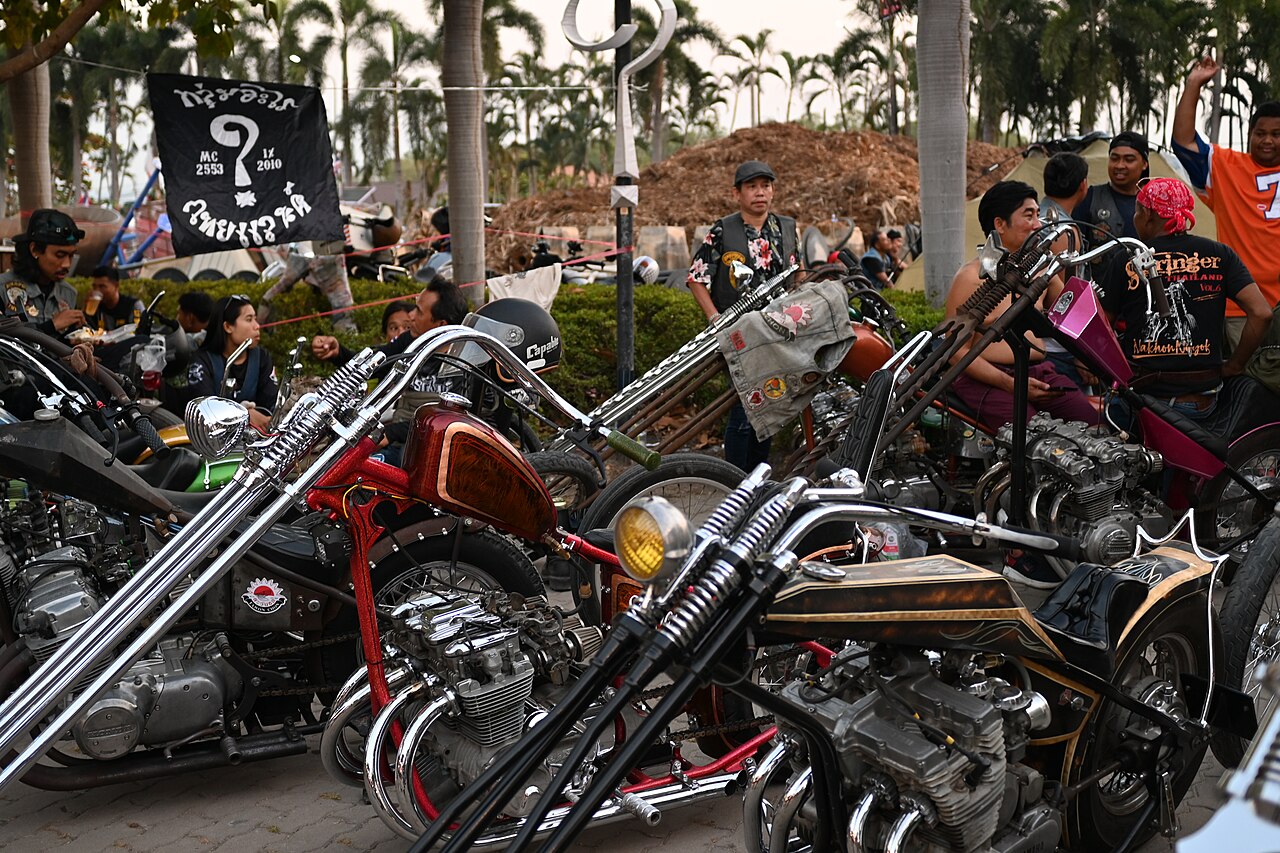
Custom choppers at a Thai rally; illustrative photograph, not a named American group. Photo: PattayaPatrol · CC BY-SA 4.0. Display crop applied where relevant.

The fastest way to ruin a group ride is to assume everybody understands the same plan. A short meeting before the engines start is not bureaucracy. It is how a group stays a group without pressuring anyone to ride beyond their comfort zone.
Give the ride a leader and a sweep
The Motorcycle Safety Foundation recommends a clearly designated lead rider and an experienced sweep at the back. The lead should understand the route and the people taking part; the sweep needs to recognize when somebody has fallen behind or stopped.
A useful briefing gives everyone a destination, a planned first stop, a fallback rendezvous point and a phone number. If a rider misses a turn, the correct response is to continue safely to a known regrouping location — not force an illegal or hazardous maneuver.
Small groups are easier to manage
MSF guidance suggests keeping a riding unit to roughly five to seven motorcycles where practical, splitting larger runs into smaller groups. That guidance is not an arbitrary limit on friendship. It recognizes that a twenty-bike convoy occupies substantial road space and can tempt riders to treat traffic signals and ordinary right-of-way as optional.
With a larger charity run, several staggered groups can still arrive at the same event without behaving as a continuous rolling roadblock. Organizers can coordinate staggered starts and planned regrouping points.
Use formation as a tool, not a test of loyalty
MSF describes staggered riding on suitable straight roads, with the second motorcycle at least one second behind on the opposite side of the lane. On bends, poor surfaces or limited visibility, it recommends single file with increased following distance. Side-by-side formation is discouraged because it removes escape space.
The important principle is room to react. A formation should never force a rider to hold a dangerous line just to preserve a pattern or position. Group road etiquette is not a substitute for local traffic law.
The three questions every rider should hear
At the start, organizers should answer three questions clearly: where are we stopping, what happens if we get separated, and who do we call if there is a mechanical or medical problem? Fuel range, rain gear and passenger experience should shape those answers.
The person on the smallest fuel tank or with the least experience shouldn’t have to announce that fact in the middle of traffic. Good leaders plan around the group they actually have, not the group they wish they had.
The ride is not a race to catch up
A lost rider should not have to gamble on red lights, high-speed passes or unfamiliar intersections. Agree that a separation is ordinary and survivable. A plan that lets riders arrive calmly is a much better test of brotherhood than one that demands they prove it at speed.
Sources and methodology
This article is based on public source documents and editorial analysis, not a claimed first-hand road test or unpublished interview.
Research desk · Biker Free Press · Reviewed November 15, 2026. Verify time-sensitive requirements at the original source.